You are sending USDT, and everything looks straightforward—until the exchange asks you to choose a network.
Ethereum or TRON?
One option shows a lower fee. The other looks more familiar. Your recipient has sent an address, but their message says only, “Send USDT here.”
This is where it pays to pause.
USDT can exist on different blockchains. Choosing the wrong one can leave your payment uncredited, create a difficult recovery problem or result in a permanent loss. Choosing the cheapest one without checking the destination is a gamble you do not need to take.
Let’s walk through the decision, including the questions that tend to come up just before—and sometimes just after—pressing Send.
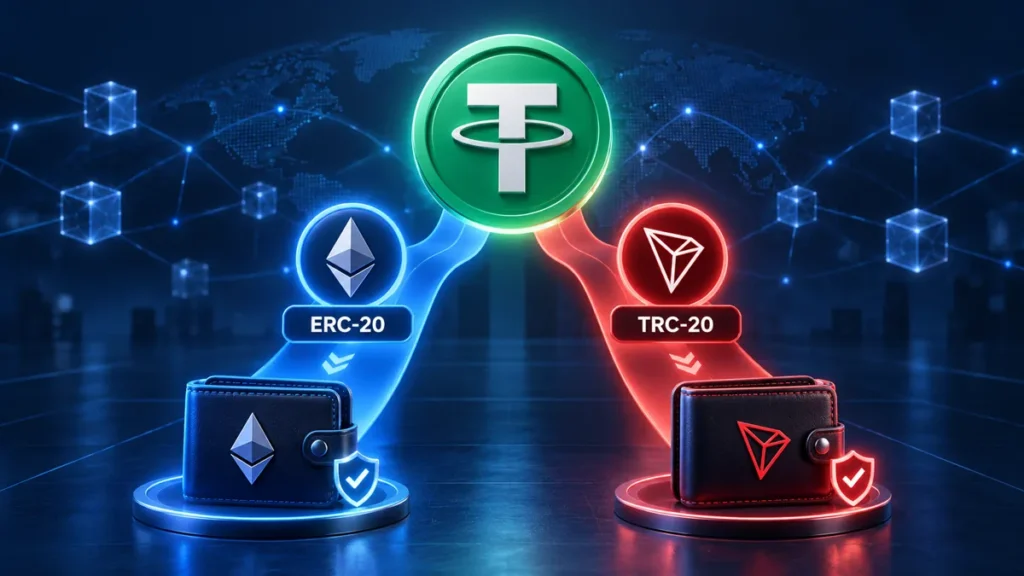
What is the difference between ERC-20 and TRC-20?
ERC-20 is a token standard widely used on Ethereum. TRC-20 is a token standard used on TRON. USDT is available on both blockchains through separate token contracts. Sources: Ethereum ERC-20 documentation and Tether supported protocols.
A token standard provides rules that allow wallets and applications to interact with a token. You do not need to understand the programming behind those rules to make a payment, but you do need to know which blockchain your transfer will use.
On an exchange, you might see:
- Ethereum (ERC20)
- TRON (TRC20)
Those labels describe different routes for moving USDT.
There is a terminology wrinkle worth knowing: ERC-20 is technically a standard, not the name of a network. When a withdrawal screen says Ethereum (ERC20), it normally refers to Ethereum mainnet. Read the full label rather than choosing from the abbreviation alone.
Does that mean there are two different USDT prices?
Both versions are intended to represent Tether’s dollar-linked token. Selecting a network is not the same decision as choosing between USDT and USDC.
However, your balances exist on separate blockchains. Having USDT on Ethereum does not automatically give you a spendable USDT balance on TRON.
Think of the network as part of the payment instructions, not an optional preference you can change after sending.
For the differences between the stablecoins themselves, see our USDT vs USDC comparison.
Why can’t I send USDT through whichever network has the lowest fee?
Because the receiving wallet or platform must support the exact asset on the exact network you select.
Suppose a supplier’s deposit page accepts USDT through TRON. Your exchange offers an Ethereum withdrawal for less money.
That cheaper option does not make Ethereum suitable for the supplier’s TRON deposit instructions.
Tether specifically warns users to check the transport protocol and destination carefully because an incorrect selection can result in unrecoverable funds.
Before comparing fees, confirm three things together:
USDT + the receiving network + the receiving address.
If any one of those is unclear, ask the recipient to confirm it.
A message saying “I accept USDT” is a starting point. It is not a complete set of transfer instructions.
ERC-20 vs TRC-20: what should I compare?
| What matters? | USDT on Ethereum | USDT on TRON |
|---|---|---|
| Common withdrawal label | Ethereum or ERC20 | TRON or TRC20 |
| Token standard | ERC-20 | TRC-20 |
| Typical address shown to users | Starts with 0x |
Starts with T |
| Ordinary network cost mechanism | Gas, settled in ETH | Bandwidth and Energy, with TRX used where required |
| Essential receiving check | Does the destination accept USDT on Ethereum? | Does the destination accept USDT on TRON? |
| Relevant cost when using an exchange | The exchange’s current withdrawal quote | The exchange’s current withdrawal quote |
The address formats are clues, rather than guarantees. TRON documents its usual T address format, while MetaMask explains how the same Ethereum-style address can be used across multiple compatible networks. A valid-looking address therefore does not establish that a particular deposit route is supported.
The most useful comparison is the one based on your actual payment.
Is TRC-20 always cheaper than ERC-20?
No. Compare the current quote rather than relying on a permanent rule.
You will find plenty of guides describing TRON as the cheap option and Ethereum as the expensive one. That shortcut leaves out an important distinction: an exchange withdrawal and a transfer from your own wallet do not necessarily carry the same charge.
What is a network fee?
It is the cost of processing a transaction on the blockchain.
What is an exchange withdrawal fee?
It is the amount a platform charges to send cryptocurrency out of your account.
For an exchange withdrawal, read the final quote. Kraken, for example, states that withdrawal fees can change and that the final amount is shown at confirmation.
Do not assume a fee you saw in a video, screenshot or older article still applies to your account today.
Also check whether the fee is added to your entered amount or deducted from it. That difference matters when someone expects an exact payment.
Can you show a practical fee comparison?
Imagine you owe a freelancer 500 USDT.
They confirm that both Ethereum and TRON are accepted. Your exchange presents these hypothetical charges:
| Route | Amount the freelancer receives | Withdrawal charge | Total balance required |
|---|---|---|---|
| Ethereum | 500 USDT | 0.80 USDT | 500.80 USDT |
| TRON | 500 USDT | 1.50 USDT | 501.50 USDT |
In this example, Ethereum costs 0.70 USDT less.
These are illustrative figures, not current exchange quotes. They assume the charge is added to the payment.
Now change one detail: the freelancer accepts only TRON.
The Ethereum option is no longer a suitable route, regardless of its lower charge.
What if the fee is deducted instead?
If you enter 500 USDT and the platform deducts a 1.50 USDT charge, the recipient receives 498.50 USDT.
You may then need another transaction to settle the shortfall.
Read the recipient receives field before confirming. For an invoice, agree in advance who covers the fee and how much must arrive.
What about the recipient’s next transfer?
Ask that too.
If they need Ethereum USDT for their next step, receiving it through TRON could create another conversion or withdrawal cost. The cheapest first transaction is not always the cheapest complete journey.
Our guide to why crypto transfer fees vary explains why looking at the full route is more useful than comparing one headline figure.
Why does my wallet ask for ETH when I am sending USDT?
An ordinary USDT transfer on Ethereum requires gas, and Ethereum settles gas fees in ETH.
The USDT balance pays the recipient. The ETH balance pays the network.
That is why a wallet can show enough USDT for your payment but still refuse to send it: you may not have enough ETH for the transaction charge.
The gas cost depends on execution requirements and the applicable gas price. A token transfer should not automatically be priced like a simple ETH transfer. Sources: Ethereum gas overview and technical gas guidance.
Your wallet should estimate the fee before you confirm.
Some applications sponsor fees or offer alternative payment arrangements. Ethereum’s documentation describes paymasters as one way a service can cover gas for users. However, that is a feature of a particular service—not something every wallet provides.
Check the wallet you are actually using instead of assuming another app’s instructions apply.
How do TRON fees work? Do I need TRX?
TRON uses Bandwidth and Energy to account for network resources. If sufficient resources are unavailable, TRX can be burned to cover the applicable shortfall.
Bandwidth relates to transaction size. Energy relates to smart-contract execution, including token transfers.
Resources can be obtained through staking or delegation. Network parameters also affect how the system charges for them. Sources: TRON Bandwidth and Energy and paying for resources.
For a beginner, the important point is simpler than the terminology: holding USDT on TRON does not automatically mean you can send it without considering resources or fees.
Read your wallet’s estimate.
Be particularly cautious if a stranger offers to “activate” your wallet or arrange free transfers by connecting it to an unfamiliar website. Lower fees are not a reason to share a recovery phrase or approve a permission you cannot explain.
If that has already happened, our guide to connecting a wallet to a suspicious website explains how to assess the interaction.
Which is faster: Ethereum or TRON?
Your waiting time depends on the entire transfer process, including both platforms—not just the blockchain.
A withdrawal may go through four stages:
- The sending platform processes the request.
- The transaction is broadcast.
- The blockchain includes and confirms it.
- The receiving platform credits the deposit.
Kraken’s documentation distinguishes a broadcast withdrawal from a deposit with enough confirmations to be credited. They are separate milestones.
This explains why someone can truthfully say “the transaction is confirmed” while the exchange balance has not updated yet.
For a deadline-sensitive payment, check the receiving service’s confirmation requirements and current deposit status. A network’s advertised speed does not remove an exchange’s internal processing time.
Do not send the payment again simply because the first transfer is taking longer than expected.
Can I identify the right network from the address?
Use the address as a clue, then confirm the network through the receiving service.
A typical TRON address starts with T. An Ethereum-style address begins with 0x.
The catch is that multiple networks use Ethereum-style addresses. The same account address may exist on several compatible chains, while its assets remain on separate ledgers.
MetaMask explains this shared address format in its network guidance. It does not mean every platform accepts deposits through every compatible blockchain.
For example, an exchange may provide a 0x address specifically for an Ethereum deposit. Sending through another network because the address “looks the same” can still produce an unsupported deposit.
Use the current receiving screen as your reference.
How do I send USDT safely?
Start with the receiving account
Open the official wallet or exchange app. Choose USDT and select the intended deposit network.
Read the minimum amount and any additional instructions.
Match that network on the sending platform
Confirm that the sender supports the same route. Kraken’s multiple-network documentation illustrates how a single cryptocurrency can have several deposit and withdrawal options.
Verify the address
Copy it from the current deposit screen. Check it again after pasting.
If a client or supplier changes payment instructions, confirm the change through a separate trusted channel before sending.
Review the final amount
Check both the charge and the amount the recipient will receive.
Consider a test payment
Where practical, send a small amount that meets the destination’s minimum.
A test below that minimum may not be credited. Kraken specifically tells users to account for deposit minimums after relevant deductions.
Confirm receipt before sending the remainder
Check the receiving account or ask the recipient to verify the credit.
A successful test helps check the route. It does not verify that a seller, investment or business is trustworthy.
What happens if I choose the wrong network?
Recovery may be possible in some circumstances, but it is never something to assume.
The outcome depends on the destination, the networks involved and who controls the receiving account.
What if I sent it to an exchange?
Contact the exchange’s official support team.
Provide the transaction hash, sending network, receiving address, asset and amount. The platform may offer recovery, charge a fee or be unable to assist.
Kraken warns that withdrawals through incompatible networks can result in permanent loss.
What if I control the receiving wallet?
Sometimes the problem is a missing token display or the wrong network view. MetaMask explains how to display tokens and check their transaction and contract details.
However, that does not establish that every mistaken transfer is recoverable.
Can Tether help?
Tether advises contacting the receiving party first when tokens reach an unsupported destination. Its recovery assistance is evaluated case by case.
Do not pay an unsolicited “recovery expert” or give anyone your private keys. Our crypto recovery scam guide explains the warning signs.
Can I convert TRC-20 USDT to ERC-20 USDT?
Yes, through a service that supports the required route. Changing your wallet’s selected network does not perform the conversion.
Two common approaches are worth understanding.
Using an exchange
An exchange may accept a USDT deposit through one network and allow a withdrawal through another.
Check both options before depositing. Also consider minimums, withdrawal charges and any account restrictions.
The process may look like choosing another item from a dropdown, but it works only because the platform supports the underlying routes.
Using a bridge
A suitable bridge may move value between networks, but you must check the exact asset you will receive.
Ethereum’s documentation describes bridge risks involving smart contracts, operators and wrapped assets. A familiar ticker does not tell you everything about the resulting token.
Before using either approach, ask: “What arrives, on which network, and what will the complete process cost?”
If you cannot answer that clearly, stop and investigate further.
How do I know that my USDT token is genuine?
Check its contract details against Tether’s official documentation on the correct network.
A logo, ticker or balance screenshot is not enough to identify a token. Another contract can use a familiar name.
Tether publishes different USDT contract details for Ethereum and TRON. Use its supported-protocol page as your starting point.
Keep these addresses separate in your mind:
- Token contract address: identifies the token.
- Receiving address: tells the sender where the payment should go.
Do not use the token contract address as your payment destination.
If you are checking a transaction, confirm the network, token contract, recipient and amount together.
I’m a freelancer. Which network should I request from a client?
Request a network you can receive and use through services available to you. Agree on it before the client sends anything.
The client’s cheapest withdrawal option may be inconvenient for you if you then need to move the funds elsewhere.
Before accepting the payment, establish:
- The network you both support.
- The amount that must arrive.
- Who pays the transfer charge.
- Whether you need a test payment.
- How any changed instructions will be verified.
For example:
“Please confirm the USDT network before sending. The invoice amount is 500 USDT received. Contact me through our usual channel before using any replacement address.”
Keep an appropriate payment record, including the transaction hash.
Network choice is one part of the arrangement. It does not remove custody risks, stablecoin risks or your responsibility to check applicable local requirements.
My transaction is confirmed, but I haven’t received USDT. What now?
Check the transaction on the correct blockchain, then compare it with the receiving instructions.
Start with the transaction hash rather than a screenshot alone.
Confirm:
- The network used.
- The destination address.
- The token contract.
- The amount transferred.
- The transaction status.
A missing balance may involve token display, an unsupported network, minimum deposit requirements or the platform’s crediting process.
MetaMask recommends obtaining the transaction hash and token address when investigating tokens that do not appear.
If an exchange controls the destination, send those details to official support.
Avoid making another transfer while the first remains unexplained. It creates more exposure without resolving the original question.
Frequently asked questions
Is TRC-20 the same as TRX?
No. TRX is TRON’s native asset. TRC-20 is a token standard used on TRON. USDT is a separate token using that standard. Source: TRON wallets and accounts.
Is ERC-20 the same as ETH?
No. ETH is Ethereum’s native asset. ERC-20 is a standard used by tokens, including Ethereum-based USDT. Holding USDT does not automatically mean you hold ETH for gas. Sources: ERC-20 standard and Ethereum gas.
Will sending more USDT automatically mean paying proportionally more gas?
Not generally. Ethereum gas reflects execution requirements and gas pricing rather than a straightforward percentage of the payment. A platform can separately apply its own charges. Source: Ethereum gas documentation.
Is one network automatically safer?
There is no useful universal answer for an individual payment. You must also consider the receiving platform, token authenticity, wallet permissions, destination and any bridge involved. A correct network selection cannot make an untrustworthy recipient safe.
Does a test payment guarantee that the main transfer is safe?
No. It can help confirm that a particular route works. It does not verify an investment claim or protect you if you later change the address, asset or network.
What should I choose before pressing Send?
Choose the route you can verify from beginning to end.
Start with compatibility. Then compare the full cost. Finally, check the address, amount and receiving requirements.
For a quick final review:
- Asset: Is the recipient expecting USDT?
- Network: Do both sides support the exact same blockchain?
- Address: Did you obtain and independently verify the current destination?
- Amount: Will the required amount arrive after charges?
- Requirements: Have you checked minimums and additional instructions?
- Test: Is a suitable test transfer practical?
The right answer to ERC-20 versus TRC-20 depends on the payment you are making. A modest fee saving is useful only when the money reaches a destination that can accept and use it.
Use our crypto safety checklist before proceeding. It requires no wallet connection.
This article provides general education, not personalised financial, tax or legal advice. Network support, charges and platform requirements can change. Check current official instructions before transferring funds.